Approximations of MPC: Dynamic KKT & Learning based Approaches
107 Views
February 18, 26
スライド概要
セビリア大学での招待講義の資料です。

制御工学の研究者です。
関連スライド






各ページのテキスト
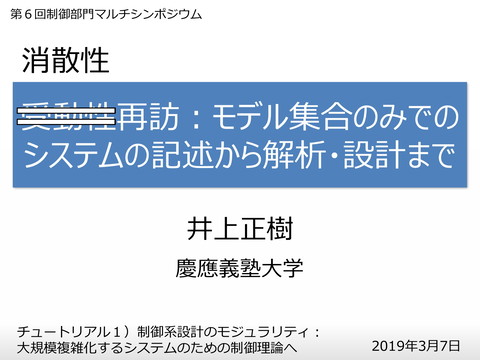
Approximations of MPC: Dynamic KKT & Learning based Approaches Masaki Inoue Keio University [email protected] Seminar, University of Seville May 30, 2022
Various Control Applications Air Traffic Management Energy Management fuel efficiency safety Light Guidance Control reduced discomfort complex driver behavior 2 stability economic dispatch Smart Agriculture reduced workload preferred environment
Model Predictive Control (MPC) • Plant Model • extended vector • Control Law ex. model-based state prediction: • find optimal action based on the measured state • handle complex design specifications • require real-time solution of optimization problem 3
Approximation of Control Law 4 ➢Control Law in MPC ➢Optimality Condition: inequality constraints are omitted in this talk (can be extended) • Karush–Kuhn–Tucker (KKT) condition essence of high computational burden • control law is given by implicit function like ➢Aim of this talk: Approximation of control law by explicit function like
Two Approaches MPC i. 5 approx MPC Approximation by dynamic KKT (instant MPC) • original work: [K. Yoshida et al, IEEE LCSS, 2019] • extensions: [M. Figura et al, ACC, 2020], [K. Sato et al, SICE AC, 2020] ii. Approximation by learning technique • [K. Hara et al, IFAC WC, 2020], [K. Hara et al, Automatica (conditionally accepted)] • Others by many researchers • explicit MPC: [Bemporad et al, Automatica, 2002] etc • neural network based MPC: [T. Parisini & R. Zoppoli, Automatica, 1995] etc
Outline 1. Preliminary: Dissipation-based System Analysis • tool for closed-loop stability of approximated MPC 2. Dynamic KKT-based Approximation of MPC 3. Learning-based Approximation of MPC 6
1. On System Description ➢ State equation • basic description of dynamical systems • express detailed behavior of IO dynamical system • systems interconnection increases state space dimension state equation is not always tractable for large-scale system analysis & design
1. Differential Equation & Inequality (revisit) ➢ 1-dim differential equation ➢ 1-dim differential inequality • is a description of a set of dynamical systems • express rough behavior of dynamical system ➢ Model “Reduction” of state equation finding energy function reduced to 1-dim diff inequality
1. Description by Dissipation Inequality ➢ Dissipation inequality (Willems) • special case: QSR dissipativity (Hill & Moylan) upper bound of energy increase • Im Example 1: bounded L2 gain Im 0 • Example 2: passivity Re Re 0 Nyquist diagram
1. Feedback Connection ー ➢ Assumption: dissipation in subsystems connected as ➢ Dissipation in feedback system • evaluated by sum of energies
1. Stability Theorem ー ➢ Dissipation in feedback system ➢ Theorem: Suppose (*) is negative (semi)definite. Then, the origin of FB system is asymptotically (Lyapunov) stable • small-gain theorem: , • passivity theorem: , • only few parameters are required for stability analysis (NO detailed model like state equation)
Outline 12 1. Preliminary: Dissipation-based System Analysis • tool for closed-loop stability of approximated MPC 2. Dynamic KKT-based Approximation of MPC • Main Reference: [K. Yoshida et al, LCSS, 2019] 3. Learning-based Approximation of MPC MPC approx MPC
2. Dynamic KKT ➢ KKT condition (recall) optimization problem ➢ dynamic KKT condition • reduced to KKT condition at steady state ( • primal-dual gradient algorithm: ) [K. J. Arrow et al, Studies in Linear and Non-Linear Programming, 1958] • extension to handle inequality constraints: [A. Cherukuri et al, SCL, 2016], [A. Adegbege, IFAC WC, 2020]
2. Instant MPC ➢ Instant MPC: dynamic controller realized by optimization algorithm associated with MPC approx MPC • less approx. error for slow dynamics • No error at DC gain • explicit control law like • sketch for discrete-time algorithm case MPC iMPC objective function
2. Demonstration of instant MPC ➢ Attitude control of aircraft [K. M. Sobel et al, JGCD, 1985] ➢ Simulation results • suboptimal performance • constraint violation for some algorithm • avoided by other PDG algorithm [A. Adegbege, IFAC WC, 2020] • significantly reduce computational burden MPC(cplex) 18.13 ms iMPC 0.2070 ms
2. Stability Analysis of instant MPC ➢ Assumption: dissipativity of plant system iMPC ➢ Extension of instant MPC • add tunable parameters that do not shift the steady state Note: at steady state ➢ Theorem: existence of parameters s.t. • dissipativity of iMPC: • close-loop stability:
2. Short Summary on instant MPC MPC iMPC ➢ Instant MPC: suboptimal control realized by solution algorithm Main Reference: [K. Yoshida et al, LCSS, 2019] • guarantee optimality at steady state • related works: [A. Jokic et al, TAC, 2009], [L. Lawrence, TAC, 2021] • guarantee closed-loop stability based on dissipation theory
Outline 18 1. Preliminary: Dissipation-based System Analysis • tool for closed-loop stability of approximated MPC 2. Dynamic KKT based Approximation of MPC • main reference: [K. Yoshida et al, LCSS, 2019] 3. Learning-based Approximation of MPC • main reference: [K. Hara et al, IFAC WC, 2020], [K. Hara et al, Automatica (conditionally accepted)] MPC approx MPC
3. Learning MPC 19 ➢Idea of data-driven approximation • collect input-output data on optimal control law offline • apply data-driven modeling to find explicit control law MPC data collection approx MPC modeling ➢Related (classic) works • neural network-based approximation of optimal control: [D. Psaltis et al, CSM, 1988], [T. Parisini el al, Automatica, 1995] ➢This work: stability-preserving data-driven approximation
3. Controller Structure 20 ➢Approximation of observer-based MPC • find suitable lifted state • observer MPC e.g. radial basis function approximation • state equation for controller • focus trajectory of lifted state • nonlinear in state • linear in system matrices , not of state & lifted state ➢Preliminary for data-driven approximation • perform offline simulation of MPC to generate • transform to lifted state & input
3. Dissipativity-Constrained Learning ➢Preliminary 2: • impose dissipation specification approx MPC ➢Formulation: dissipativity-constrained learning control performance closed-loop stability • nonlinear matrix inequality is reduced to LMI [Y. Abe et al, ECC, 2016] • idea for reduced conservativeness [K. Hara et al, IFAC WC, 2020] etc 21
3. Demonstration 22 ➢Nonlinear plant: • passive [H. Zekari & P. Antsaklis, IJC, 2019] ➢Suboptimal controller design: Simulation result: • MPC & observer design • IO data collection • passivity-constrained learning ーpassivity-constrained ーno-constrained closed-loop stability
Summary: Approximation of MPC 1. Dynamic KKT-based Approximation • instant MPC is realized by optimization algorithm associated with MPC • guarantee optimality at steady-state • stability analysis by dissipativity theory 2. Learning-based Approximation • guarantee stability by dissipativity-constrained learning • suboptimality analysis by Koopman operator theory (omitted) • present LMI-based solution method (omitted) MPC approx MPC 23